
“Learn the rules like a pro, so you can break them as an artist.”
-Picasso
Modernism itself breaks away from other traditional art movements with the intention of exploring for artistic expression in the current era.
Firstly, to be considered modern, said art usually focuses on aspects that are currently present at the given time. Rather than repeat what had already been established by artists prior, modernism relied more on experimentation with subjects and techniques to create something new.
Cubism fits under this umbrella as it was a new style invented in the 1900s.
Created by famed artists Pablo Picasso and Georges Braque, cubism takes various forms to “show different viewpoints at the same time and within the same space”, relying less on depth (Tate). At the time, this attempt at perspective was unprecedented as no one viewpoint was clearly visible due to a chaotic composition.
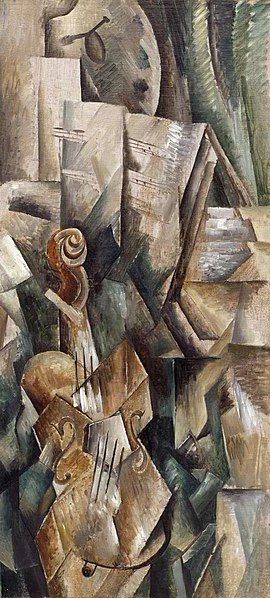
Braque’s 1909 Violin and Palette showcases his experimentation with cubism with the abstraction of a violin. Along with neutral hues to limit spacing, he persuades the viewer to “concentrate on the [style] rather than … the subject matter” (TheArtStory). Since a violin, a present time object, is the main subject, it aligns with the modern ideal of including real-life observation to give new meaning to the specific matter.
Braque, Georges. Violin and Palette. c.1909. Guggenheim Museum, New York. (source)

The same meaning applies to Picasso’s abstraction of a guitar. Pushing further in the capabilities of this new style, one can see his effort to translate this piece to the third dimension. Similar to Braque, a condensed range of values is utilized as Picasso primarily focused on shape.
Picasso, Pablo. Guitar. c.1914. Paris, France. (source)
The key concept of Modernism is portraying “a subject as it exists in the world, according to [the artist’s] unique perspective” without conforming to tradition (TheArtStory). This rejection is clearly represented in the very existence of Cubism, as it was unprecedented in the world of art. From one’s perspective, it would be hard to analyze Picasso’s and Braque’s innovation without seeing its major link to its predecessor.
Additional Resources:
- “Cubism Movement Overview.” The Art Story, www.theartstory.org/movement/cubism/.
- “Cubist Sculpture I (Article) | Cubism.” Khan Academy, Khan Academy, www.khanacademy.org/humanities/art-1010/cubism-early-abstraction/cubism/a/cubist-sculpture-i.
- “Modern Art – Development and Ideas.” The Art Story, www.theartstory.org/definition/modern-art/history-and-concepts/.
- Tate. “Cubism.” Tate, www.tate.org.uk/art/art-terms/c/cubism.